


The furnace lining of a Walking Beam Reheating Furnace operates at high temperatures for prolonged periods. Traditional refractory insulation materials are prone to degradation, such as powdering and peeling due to crystal phase transformation, reducing the insulation effectiveness and increasing heat loss. In severe cases, cracks may appear in the furnace wall, leading to creep in the outer steel shell and even potential burnout.
Modern insulation materials in China have significantly improved in thermal performance and structural durability. When selecting insulation for Walking Beam Reheating Furnaces, factors like thermal conductivity and thermal resistance should be carefully analyzed. High-quality insulation materials with low thermal conductivity and low heat storage should be used for furnace walls, roofs, bottoms, and supporting tubes. If needed, an additional insulation layer can be added to further reduce heat loss.
Significant heat loss can occur through charging/discharging doors, inspection ports, slagging ports, and slag discharge holes, especially in end-charging Walking Beam Reheating Furnaces. To reduce this, furnace doors should be opened only as much as needed during production and kept closed during downtime. Automatic opening and closing systems are ideal. It’s also crucial to maintain proper water levels in the water-sealed slag troughs to prevent hot gases from escaping.
The exhaust gases from Walking Beam Reheating Furnaces carry considerable residual heat, which can be recovered and reused. The most efficient method is to preheat combustion air and fuel gas, thereby improving thermal efficiency and reducing gas consumption. Additionally, waste heat can be used to generate steam, electricity, or for other industrial applications, further improving energy efficiency.
The furnace roof is one of the most vulnerable areas due to high thermal stress. The structure includes refractory castables, insulation layers, anchor bricks, and burners. Proper design and material selection can extend the service life and maintain optimal performance.
Earlier designs used cast hooks hung on I-beams, which caused stress concentration, leading to cracking. Yinuo has improved the system by replacing I-beams with rotatable φ60mm steel pipes and stainless-steel bent rods to allow flexibility and reduce stress on anchor bricks.
Roof partitions are small and exposed to high temperatures on both sides, making them prone to damage. Yinuo uses prefabricated high-fired blocks instead of cast-in-place components. These blocks are supported by welded anchor hooks on water-cooled pipes and feature 10mm high-alumina fiber mats between joints to absorb stress.
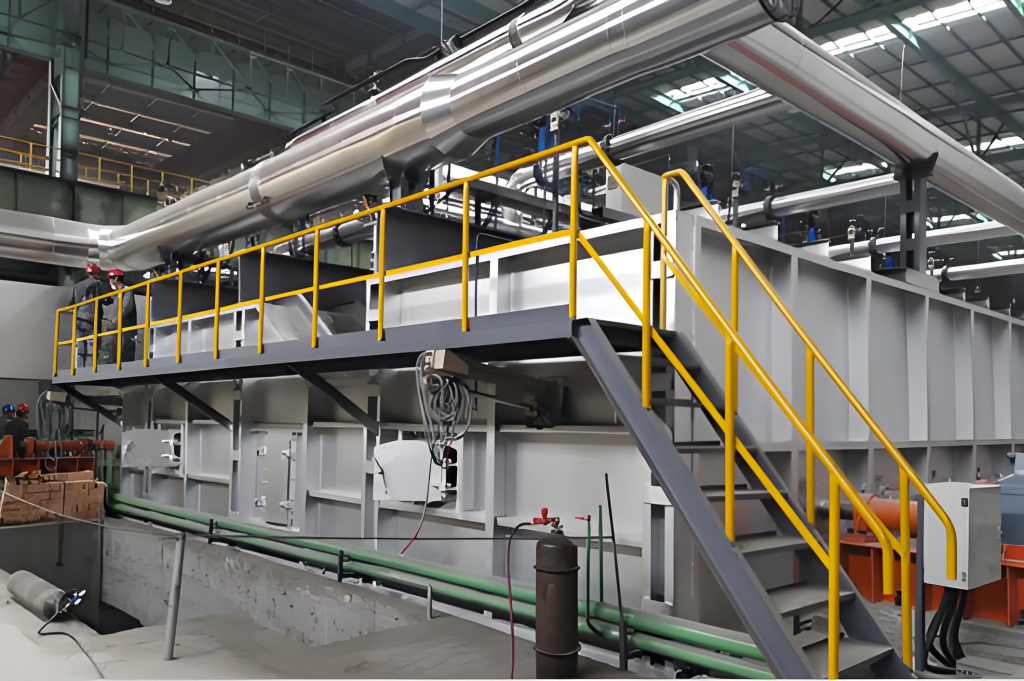
Refractory materials used in Walking Beam Reheating Furnaces must meet four criteria: safety, longevity, insulation, and lightweight structure. Selection depends on aluminum content, compressive strength, thermal shock resistance, linear expansion coefficient, conductivity, softening temperature, and volume stability.
The working layer, especially in the heating and soaking zones, is exposed to extreme thermal conditions. A castable such as GD-65, a high-performance low-cement type with over 65% Al₂O₃ content, is selected for its durability, excellent thermal shock resistance, and strong sintering behavior starting at medium temperatures (800–1200°C). This ensures both high strength and structural stability without the weakness seen in conventional materials.
Large-scale Walking Beam Reheating Furnaces can contain over 3,600 anchor points. Uneven stress during operation or poor-quality anchor bricks can cause cascading failures and even total roof collapse. During commissioning, rapid dehydration causes upward deformation and thermal stress. Proper material selection and uniform stress distribution are essential.
Burner bricks are exposed to flame temperatures exceeding 1600°C and are crucial for combustion stability. Currently, high-alumina, low-cement bonded bricks are widely used. Their failure is mainly due to poor thermal shock resistance. Cracks form during temperature fluctuations, allowing hot gases to penetrate and accelerate erosion. To improve longevity, burner bricks must be made from materials with excellent thermal shock resistance, erosion resistance, and mechanical strength.
At Yinuo Thermal Energy, our Walking Beam Reheating Furnaces are engineered for long service life, high thermal efficiency, and environmental responsibility. Through advanced materials, optimized structural design, and energy-saving systems, we help clients maintain stable operations while reducing energy costs and emissions.

